Capability-Driven Self-Evolution of Agent Memory
TL;DR: Evolving memory programs around capabilities improves overall performance.

Welcome to my Homepage! 👋
I am an M.S. student in Data Science at University of California, San Diego. I received my B.S. in Data Science and Big Data Technology from Southern University of Science and Technology in 2025. From March to September 2026 I was a research intern in the AI Memory Systems Team at Microsoft Research Asia, starting my research on AI memory and Recursive self-improvement (RSI) under the supervision of Qianxi Zhang and Qi Chen.
My research interest is understanding and optimizing agentic AI systems (e.g., long-term memory and self-evolving agents). I am interested in how to maximize agents' capabilities from their own experience at test time adaptation: PRISMEM guides memory program evolution through explicit capability dimensions rather than a single aggregate score. SkillHEX evolves agent skills at test time through hypothesis-driven exploration and exploitation. I also work on how long-horizon agents should organize what they remember: MESA selects the right memory structures for each query, and MAGE treats memory as execution state instead of a pool of similar facts. Recently, I am exploring the intersection of AI for Games and World Models, focusing on how memory architectures can preserve long-horizon consistency to drive more coherent, robust, and self-evolving agent dynamics through Recursive Self-Improvement (RSI).
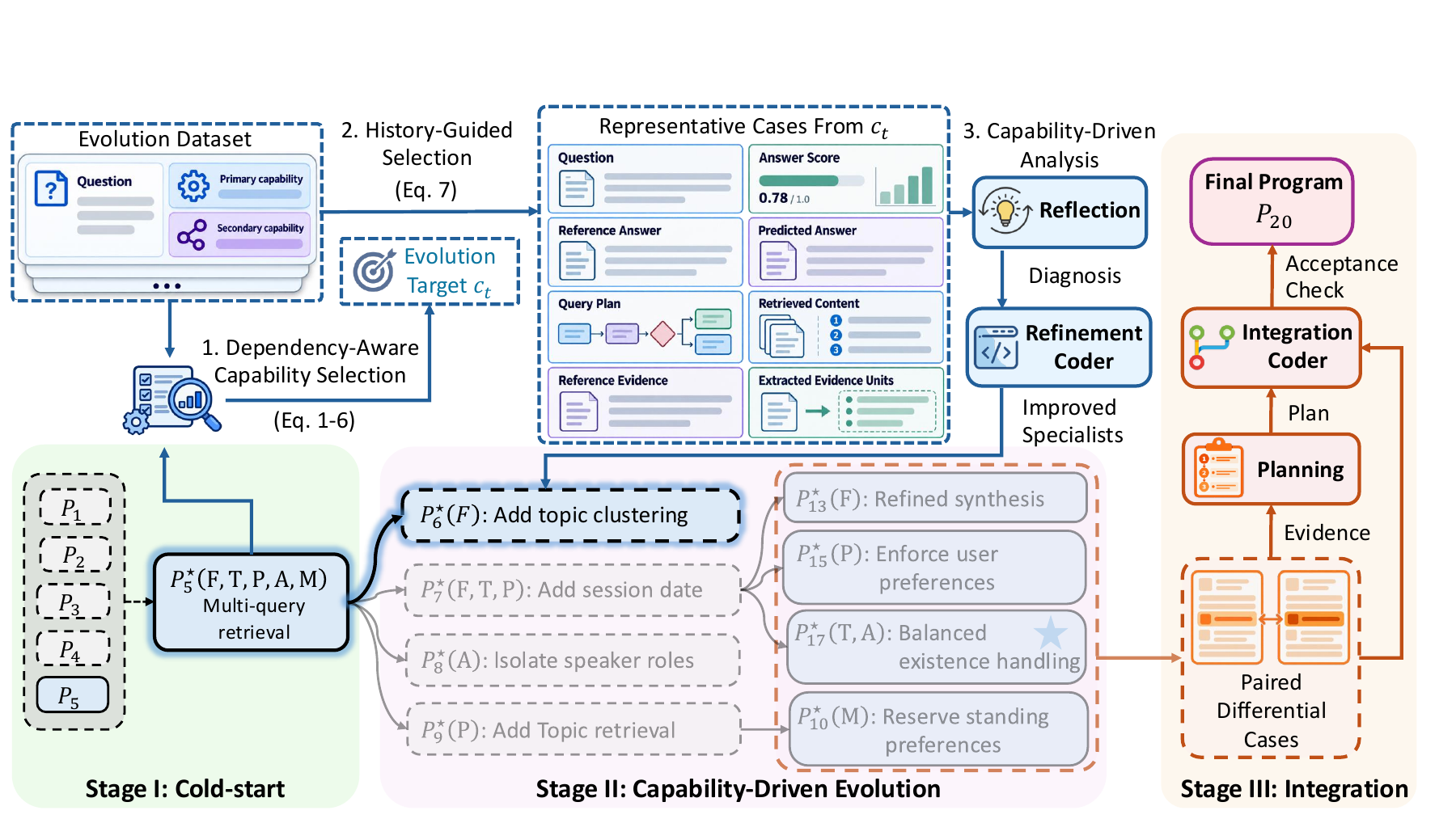
arXiv 2026 · Microsoft Research Asia · co-first author
Existing memory self-evolution approaches typically adopt holistic evolution, which obscures optimization directions and hide capability-specific gains offset by regressions elsewhere, leaving promising directions underexplored. We propose PrisMem, which extends search guidance from overall performance to individual capability dimensions, preserving promising revisions and expanding exploration beyond the boundaries of holistic evolution. Experiments show that PRISMEM outperforms the strongest baselines by 10.54 and 7.83 pp on BEAM-1M and LongMemEval-M, respectively, demonstrating its effectiveness on million-token histories.
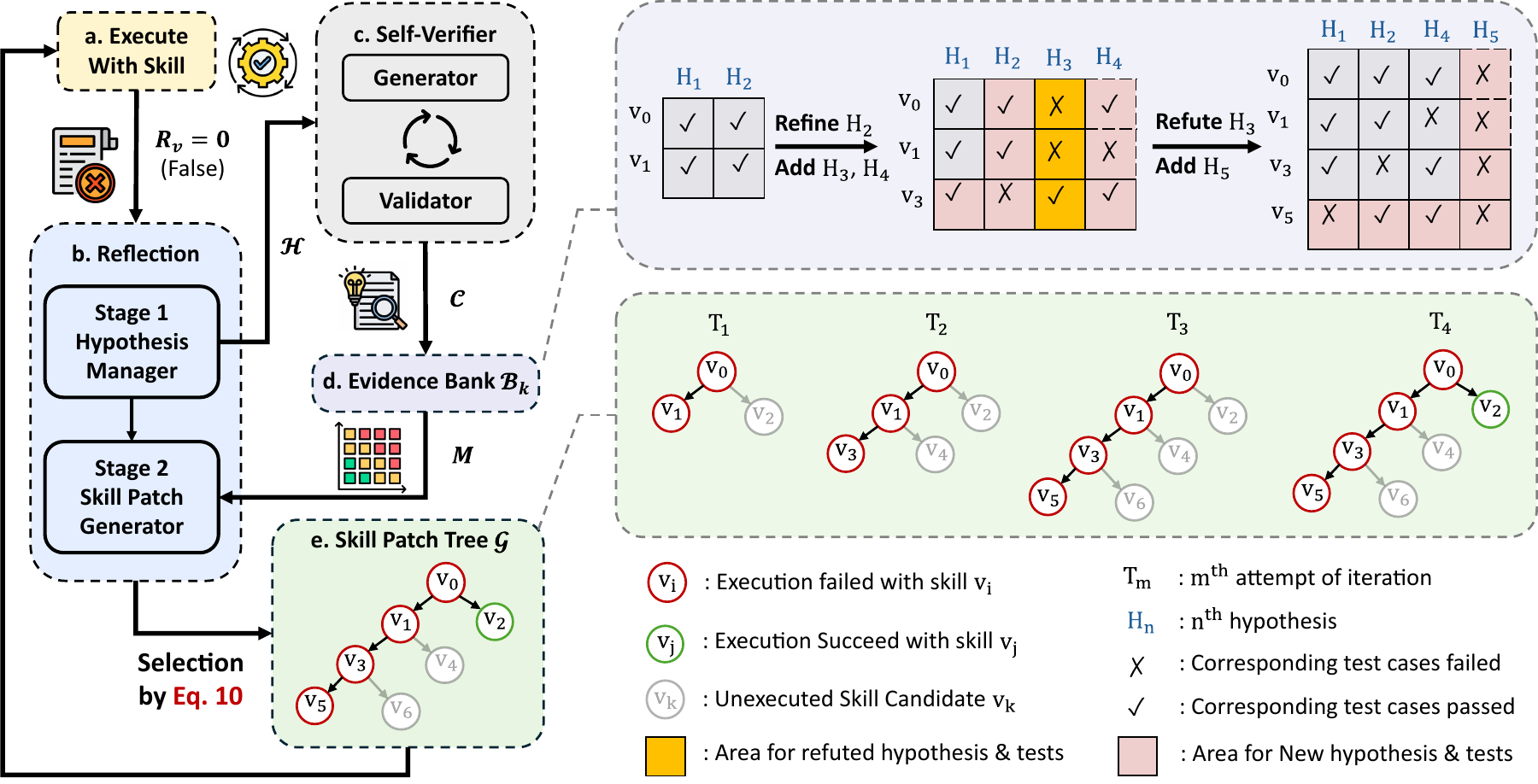
arXiv 2026 · Microsoft Research Asia · first author
Real-world deployments require autonomous, on-demand skill evolution at test time, where interaction budgets are limited and no training or validation set is available. In this setting, sparse rewards conflate multiple latent failure causes, so existing methods that greedily refine a single incumbent skill fall into an exploitation trap, exhausting their trials on early misdiagnoses. To address this, we introduce SkillHEX, a closed-loop framework coupling hypothesis-driven self-verification with evidenceguided tree search. Experiments on SkillsBench show gains of 9.5 pp over the strongest baseline.
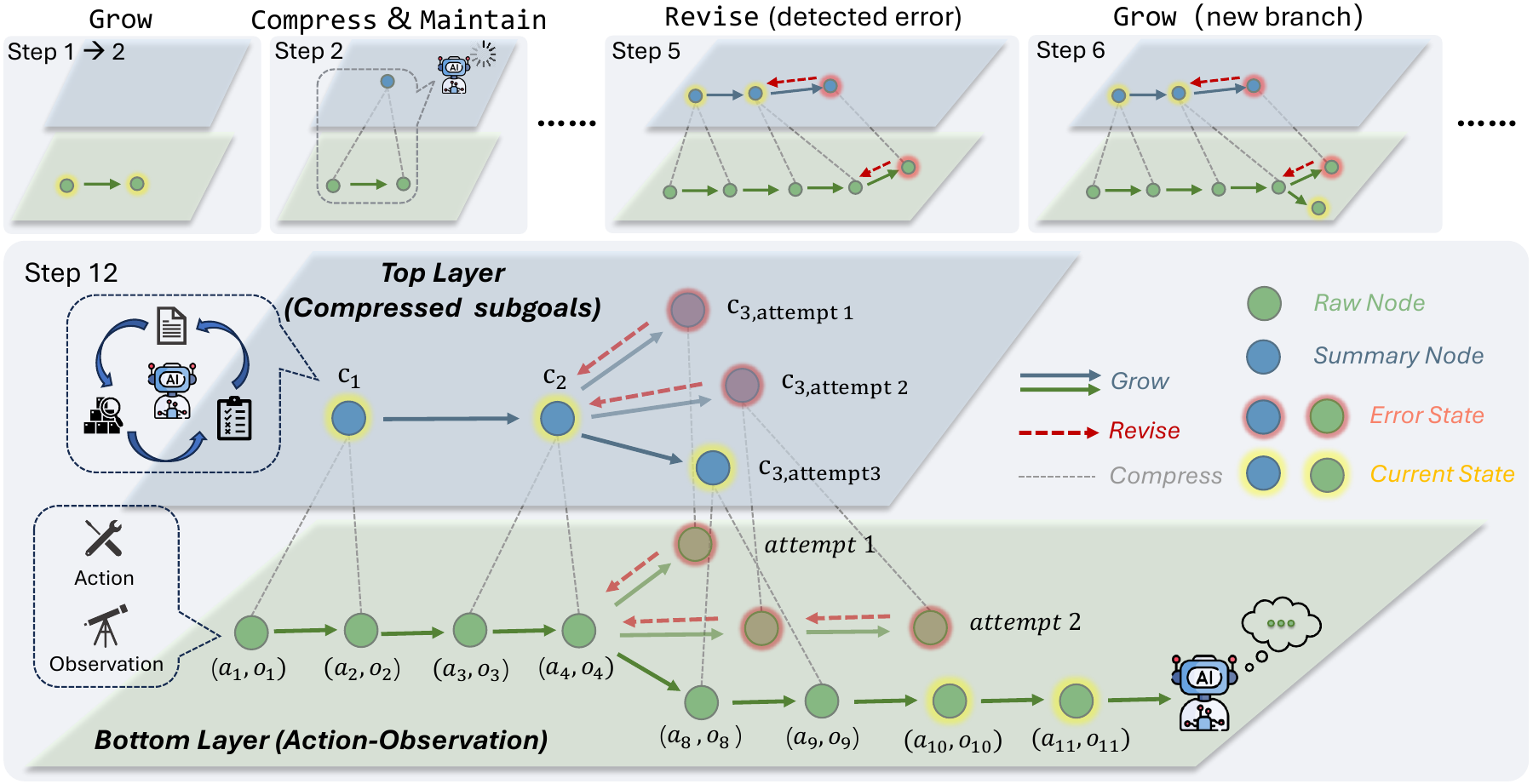
EMNLP 2026 · Microsoft Research Asia
In long-horizon agent tasks with interdependent decisions, organizing memory by semantic similarity mismatches execution-state dependencies, fragmenting decision trajectories and mixing valid with erroneous traces, which hinders state reconstruction and error isolation. We propose MAGE, an active execution-state manager that stores interactions in a hierarchical state tree. Experiments on MemoryArena show that MAGE improves the average task success rate by 7.8-20.4 pp over baselines, while reducing token consumption by 55.1%.
Also on Google Scholar. * denotes equal contribution.
TL;DR: Evolving memory programs around capabilities improves overall performance.
TL;DR:SkillHEX enables autonomous agent skill evolution under sparse rewards and limited budgets by coupling hypothesis-driven self-verification with evidence-guided tree search to balance exploration and exploitation.
TL;DR:We treat agent memory as an exploration state manager rather than a retrieval store, maintaining execution-state integrity and enabling selective error isolation for long-horizon LLM agents.
TL;DR:MESA shows task-adaptive memory structure selection is essential for long-horizon agent memory and learns to select complementary memory structures via prior-guided harness optimization.


Expected Graduation: June 2027.